The Intersection Between Childbearing and Union Status
Motivation
Diffusion over time
Figure 1: Percent of all births born in cohabitation, by country, 1970-latest
date available

Source: For Romania, Russia, West
Germany, Hungary, Norway, Austria, France and Italy data comes from
the GGS. Dutch data is from the 2003 FFS, Austrian data from GGS and
1995-96 FFS, and British data comes from the British Household Panel
Survey 1991-2004.
Variation across countries
Figure
2: Percent of all births in cohabitation, early 2000s
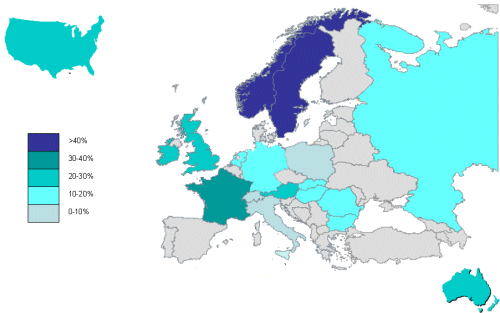
Source: For Romania, Russia, West Germany, Hungary,
Norway, Austria, France and Italy data comes from the GGS. Dutch data
is from the 2003 FFS, Austrian data from GGS and 1995-96 FFS, and
British data comes from the British Household Panel Survey 1991-2004.
Investigating the
problem
Over the past several decades, childbearing within cohabitation
has increased throughout the industrialized world. Yet little is known
about whether the pattern or underlying reasons for this increase
are similar across contexts. To better understand this problem, we
study the diffusion of nonmarital childbearing from a number of analytic
levels and methodological perspectives. Our team of researchers, called
the Nonmarital Childbearing Network, focuses on countries:
Australia, Belgium, Bulgaria, France, Germany, Great Britain, Hungary, Italy,
the Netherlands, Norway, Romania, Russia, Spain, Switzerland, the United Kingdom, and the United States.
Our first goal is to describe changes over time in union status throughout
the childbearing process. Using harmonized union and reproductive
histories from Generation and Gender Surveys or similar surveys, we
classify countries according to the prevalence of cohabitation throughout
the lifecourse: before conception, conception, birth, and one year
after birth. Contrary to claims that marriage is disappearing in Europe,
we find that marriage is not irrelevant to childbearing and early
childrearing in any country.
Second, we focus on the trends and correlates of childbearing within
cohabitation. We conduct analyses of the gap between first and higher
parity births within cohabitation, the age pattern of childbearing
by union status, and the impact of declining marital fertility rates
on the share of births within cohabitation. These analyses shed light
on how similar cohabitation is to marriage and to what extent cohabitation
is displacing marriage as a setting for childbearing and childrearing.
Third, we examine the educational gradient of nonmarital childbearing
and how it changes over time. We find that in all countries studied,
childbearing within cohabitation has a negative educational gradient,
with the exception of Italy, which has only recently experienced increases
in nonmarital childbearing. These findings challenge the Second Demographic
Transition, which posits that new family behaviors are due to increases
in self-actualization and individualism, generally practiced by those
with higher education. We propose an alternative explanation called
the "Pattern of Disadvantage." This theory argues that the social
and feminist movements of the 1960s-70s, coupled with the globalization
and rising economic uncertainty of the 1980s-90s have led to an increasing
divergence in family behaviors.
Although we aim to analyze general trends across countries, we are
aware that the development of the trends is country-specific. Therefore,
the project aims to supplement quantitative analyses with substantive
explanations. For example, we explore the social policies that could
impact or be impacted by childbearing within cohabitation, such as
the legalization of cohabitation, parental rights, tax transfers,
and single-mother benefits.
Ultimately, the project aims to develop a new theoretical framework
for understanding family change. Taken as a whole, we anticipate that
the study will provide evidence of multiple pathways to family change,
but that in general, nonmarital childbearing will be indicative of
a divergence in family formation strategies between higher and lesser
educated sections of the population. These results may indicate that
family behaviors are reproducing inequalities, thus leading to an
overall increase in inequality.